Nearly all the material a student encounters in the undergraduate physics curriculum
is based on discoveries and insights of a century or more in the past.
Newton’s laws were formulated in the 1600’s; Maxwell’s equations, 1800’s;
and quantum mechanics, early 1900’s. To give our students a sense of the present frontiers,
we encourage them to take part in frontline research of our faculty.
Of course, not every student will find it fruitful to be so engaged and not every faculty’s
research will be accessible for undergraduate participation.
At Virginia Tech, many students are involved, with different professors, to various extents,
during regular academic semesters as well as over the summer months.
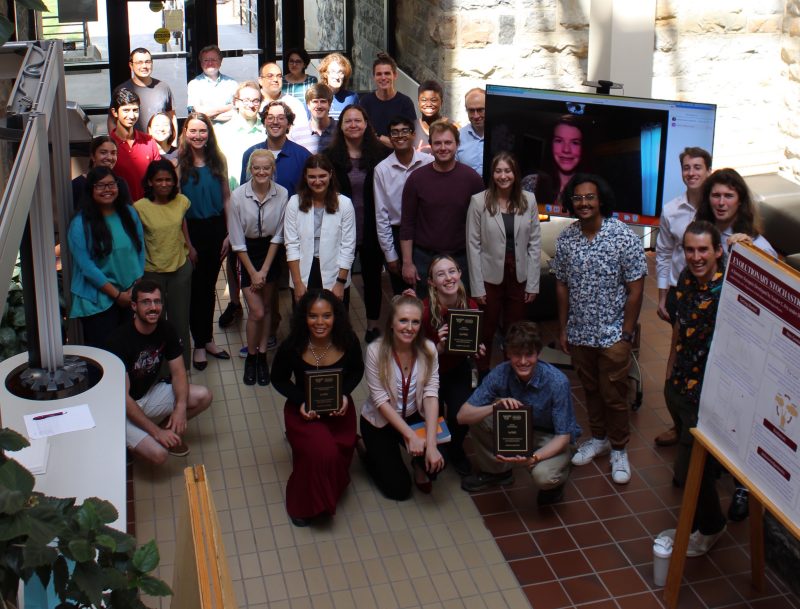
Below is a partial list of the students presently engaged in REU (Research Experience for Undergraduates),
their advisors, and the topics of their research.
In addition to gaining research experience, a student can earn wages at some hourly rate.
Alternatively, academic credits can be earned through “PHYS 2994 Undergraduate Research.”
For those in the Honors program, the work may be written up as a Senior thesis.
Justin Waugh, Physics '11, is working with Giti Khodaparast in experimental condensed matter physics. His current research projects are: photoluminescence of GaAs, photoluminescence of carbon nanotubes, carrier density and mobility measurements, at both room and low temperature limits, for the MSE department.
Sarah Reeves, Physics '11, is working with Royce Zia on statistical distribution of parasite-host systems.
Jonathan Cates, Physics '09, has been doing research in experimental condensed matter physics since June of 2007. He is working under the advisement of Giti Khodaparast in her undergraduate lab. His current research projects include photoluminescence of GaAs, carrier density and mobility measurements of GaN for the MSE department, and photoluminescence of carbon nanotubes.
Melvin Amos, Physics '09, is working with Beate Schmittmann in the Virginia Tech Stochastic Processes Laboratory in collaboration with the McNair Scholars program. He is working on a computational model dealing with tagged-particle diffusion in a totally asymmetric simple exclusion process.
Justin Bangerter, Physics '09, is working with Hans Robinson and Kai Chen on nanosphere lithography. They are trying to analyze a new method of creating mono-, bi-, and trilayered planes of hexagonally or square-packed spheres.
Dan Flisek, Physics '09, is working with Kyungwha Park. He is examining how the magnetization evolves with time in a ferromagnetic Ising model. Also, he will model a lattice of atomic magnets and examine how they react to an external magnetic field. Using a Monte Carlo computer simulation, he hopes to gain insight into the magnetization relaxation in various magnetic materials at the single-atom level.
Vojtech Gall, Physics '10, is working with Michel Pleimling on reaction-diffusion systems and trying to model them numerically. Specifically, they are looking for the occurrence of slow dynamics during these systems'relaxation towards equilibrium.
Gabriel Martinez, Physics '10, is working for Dr. Wu-chun Feng at the Virginia Tech Corporate Research Center. He is working on research with virtual machines, characterizing the performance of the different virtual machines monitors available. Examples include VMWare, VirtualBox, QEMU, and Xen.
John Hoffman, Physics '11, is working with Royce Zia (NSF-DMR-0414122+0705152) on phase transitions in a quasi one-dimensional driven diffusive system. His discoveries were reported recently in the 98th Statistical Mechanics Conference.
Julian McMorrow, Physics '09, is working with Hans Robinson on the fabrication of metallic nanostructures for surface plasmon enhancement of non-linear optical effects in polymer films.
George Daquila, Physics '06, is continuing his undergraduate research as a PhD student at VT, working with Uwe Täuber on numerical simulations for driven magnetic flux lines in superconductors with tilted columnar defects (NSF DMR-0308548).
Our students are also encouraged to participate in REU programs at other institutions around the country, typically over the summer months. Recent participants include:
Shane Seaman, Physics '09, worked at NASA Langley in the Undergraduate Student Research Program (USRP). His research group included Benny Lunsford and Tom W. Jones. They developed a 3ft. x 3ft. x 2.5ft, 173 lb. payload for the US Army's Natick Soldier Center to develop an experimental technique to support model validation of parachute design concepts. The payload that they will drop contains a GPS system, two digital cameras, a pair of force transducers, and an accelerometer/gyroscope. In addition to helping assemble the payload, Shane's primary goal was to create a LabVIEW program that will allow these devices to interface with the onboard computer and record data. The payload will be dropped from a helicopter at an elevation of approximately 1000 ft. Once the parachute begins to deploy, two camera holding pneumatic arms will deploy from the sides of the payload.
Photogrammetry techniques will then be used to map the parachute's movements during decent, and the recorded parameters will support Computational Fluid Dynamics (CFD) model validation.
Eric Christensen, Physics '09, researched thermoluminescence and optically stimulated luminescence with Dr. Vasilis Pagonis at McDaniel College in the summer of 2008.
Richard Samulski, Physics '10, worked at the University of North Carolina at Chapel Hill with Dr. Richard Superfine in the summer of 2008. He worked on diffusion experiments using fluorescent dextrans in extracellular matrix as part of a project to investigate the possibility of magnetically delivered nano-drugs.
Ashley Tabb, Physics '09, worked at the Eco-materials and Renewable Energy Resource Center (ERERC) at Nanjing University in Nanjing, China during the summer of 2008. Her mentors were Professors Tao Yu and Zhaosheng Li. She prepared oxynitride ceramic electrodes and determined their photo-electrochemical properties.
Their undergraduate research at Virginia Tech not only resulted in publications, but also contributed significantly toward their garnering the Goldwater Scholarship and the NSF Graduate Fellowship.
David Erickson, Physics and Mathematics '06, investigated phase transitions in non-equilibrium statistical mechanical systems with Beate Schmittmann and Royce Zia, carrying out Monte Carlo studies for a model for "traffic across a narrow bridge" (NSF-DMR-0414122). Currently, he is at UC San Diego, going after a PhD in Physics.
With Beate Schmittmann and Royce Zia, Brian Skinner, Physics and Mechanical Engineering '06, worked on modeling host-parasite population dynamics in the context of non-equilibrium statistical mechanicals (NSF-DMR-0414122). Brian won a coverted NSF Graduate Fellowship in his Senior year, to pursue a PhD in Physics at the University of Minnesota.
Seth Hornstein,
Physics '00, installed an H-alpha filter on the 0.4 meter telescope at Martin Observatory with
John Simonetti.
in order to search for new supernovae explosions in the nearby Andromeda Galaxy.
He also participated in an REU at the Maria Mitchell Observatory (Nantucket, MA) in the summer of 1999.
A graduate student in UCLA,
he will be getting his PhD soon.
Andrew J. Landhal, Physics and Mathematics '96, solved“a two-person perfect information game with a quantum computer” with Lay-Nam Chang. After completing his PhD in Physics in 2002 at Caltech, he went to the Center for Theoretical Physics at MIT as a postdoctoral fellow. Presently, he is a Research Assistant Professor in the Department of Physics & Astronomy at the University of New Mexico
Beth A. Reid, Physics ‘03, worked with Uwe Täuber on Monte Carlo simulations for reaction-controlled diffusion model (NSF DMR-0075725/0308548, Jeffress Memorial Trust). This work was published in Physical Review. Beth received the American Society of Physics Students' Outstanding Student Award for Undergraduate Research, and was a finalist for the American Physical Society's LeRoy Apker Award for Undergraduate Physics Achievement. She is pursuing a PhD at Princeton.
Leah B. Shaw Chock, Physics and Mathematics ’98, discovered new phases in a simple model, of non-equilibrium statistical mechanics: a driven lattice gas with anisotropic interactions, with Beate Schmittmann and Royce Zia (NSF DMR-9727574). This research was published in the Journal of Statistical PhysicsPhysica, and Computer Physics Communications. After completing her PhD at Cornell in May 2004, Leah remained briefly at Cornell as a postdoctoral fellow before moving to the Naval Research Laboratory, where she worked on theoretical/computational modeling of the spread of dengue fever. In the fall of 2007, she joined the Department of Applied Science of William and Mary as an Assistant Professor.